An 82nd Airborne soldier suspected of sexually assaulting seven women in Fort Bragg, Fayetteville and Hoke County will face a military judge Thursday.
Spec. Aaron Michael Pernell, 22, has been held in military custody at Fort Bragg since his Feb. 1 arrest. He is suspected in two break-ins and a sexual assault in December and a September break-in, all of which occurred on post.
Up periscope
Gazette.com reports that:
An Army prosecutor Tuesday opened the trial of an Iraq war veteran by accusing him of the “ultimate betrayal” — raping a comrade’s wife.
Spc. Philip C. Vermeiren, 28, is accused of assaulting the woman early Oct. 31 during an alcohol-fueled party at the Fort Carson apartment she shared with her husband.
Forensic science?
This is likely a duplicate post, but it’s worth it anyway. Here again is a piece from my old Crim. Law prof about forensics.
Paul C. Giannelli (Case Western Reserve University School of Law) (University of Illinois Law Review, Forthcoming, Case Legal Studies Research Paper No. 2010-6) has posted Daubert and Forensic Science: The Pitfalls of Law Enforcement Control of Scientific Research on SSRN. Here is the abstract:
In 2009, the National Academy of Sciences published a landmark report on forensic science: Strengthening Forensic Science in the United States: A Path Forward. The Report represents one of the most important developments in forensic science since the establishment of the crime laboratory in the 1920s. Within months, Justice Scalia cited the report in Commonwealth v. Melendez-Diaz, noting that “[s]erious deficiencies have been found in the forensic evidence used in criminal trials” and “[f]forensic evidence is not uniquely immune from the risk of manipulation.” After two years of studying fingerprints, handwriting, ballistics, and other common forensic techniques, the Academy concluded that “some forensic science disciplines are supported by little rigorous systematic research to validate the discipline’s basic premises and techniques.” Indeed, “only nuclear DNA analysis has been rigorously shown to have the capacity to consistently, and with a high degree of certainty, demonstrate a connection between an evidentiary sample and a specific individual or source.”
SEAL case update
Petty Officer Keefe’s trial is scheduled to commence in Iraq on 17 April 2010.
Here is an excellent review, by Dwight “ML” Sullivan at CAAFLog on the political posturing, pseudo-lawyering, and plain gaffs about these cases.
Hasan update 5
TDTNews reports that:
Major Hasan may not have been transferred from hospital yesterday as thought was planned.
Mr. Galligan’s chief complaint is a lack of a mitigation specialist assigned to the defense prior to the Article 32, UCMJ, hearing.
Google goes ga ga
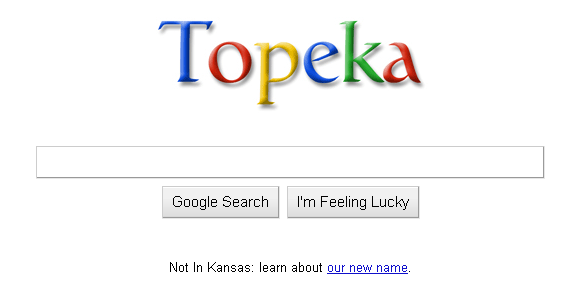
With all of the hype about Google in China it appears they have decided to change their logo to avoid Chinese intelligence agents.
Google’s explanation is rather odd.
Early last month the mayor of Topeka, Kansas stunned the world by announcing that his city was changing its name to Google. We’ve been wondering ever since how best to honor that moving gesture. Today we are pleased to announce that as of 1AM (Central Daylight Time) April 1st, Google has officially changed our name to Topeka.
Hasan update 4
Fox11.com reports that:
Major Hasan is on his way from hospital to Belton jail where he will be housed at an approximate cost of $206K.
He is wheelchair bound – question, is he a flight risk?
Search & seizure
Here’s a case from New Jersey of some interest, Stengart v. Loving Care Agency, Inc., 2010 N.J. LEXIS 241 (March 30, 2010).
[W]e find that Stengart had a reasonable expectation of privacy in the e-mails she exchanged with her attorney on Loving Care’s laptop.
Stengart plainly took steps to protect the privacy of those e-mails and shield them from her employer. She used a personal, password-protected e-mail account instead of her company e-mail address and did not save the account’s password on her computer. In other words, she had a subjective expectation of privacy in messages to and from her lawyer discussing the subject of a future lawsuit.
Up periscope
eNews Park Forest reports.
Last August, Travis Bishop refused to serve in Afghanistan. Having filed for Conscientious Objector (CO) status, Bishop, based at Fort Hood, Texas, in the US Army’s 57th Expeditionary Signal Battalion, was court-martialed and sentenced to 12 months in a military brig. He was released from the brig today.
Bishop served his time in Northwest Joint Regional Correctional Facility at Fort Lewis, Washington. This military brig is notorious for being a particularly difficult jail to serve time.
Supremes on Padilla v. Kentucky (and Denedo?)
The Supreme Court has issued an opinion in Padilla v. Kentucky, which addresses the duty to inform a client of the collateral consequences of the conviction on their immigrant status. I have posted on this in connection with United States v. Miller, 63 M.J. 452 (C.A.A.F. 2006) and other cases: here, here, here, and here. Here’s a link to Padilla on SCOTUSWiki. There are important consequences for military practitioners because as I have pointed out, there are thousands of green-card holders serving in the military. Here are a some highlights – more later.
Because counsel must inform a client whether his plea carries a risk of deportation, Padilla has sufficiently alleged that his counsel was constitutionally deficient. Whether he is entitled to relief depends on whether he has been prejudiced, a matter not addressed here.
So, to what extent does Padilla impact Denedo? Here is the SCOTUSWiki link to the Supreme Court litigation in Denedo. Here is a link to Denedo v. United States, 66 M.J. 114 (C.A.A.F. 2008). Here is a link to United States v. Denedo, in which N-MCCA denied Denedo relief again.
Court-Martial Trial Practice Blog